
Everyone Gets High Off Drugs
It's not just the people taking drugs who are using them.


[image: AI mock-up of a hypothetical US anti-drugs unit]
When US President Donald Trump needed an excuse to kidnap Venezuela’s anti-American dictator Nicolas Maduro, he turned to drugs. The White House justified extra-judicial airstrikes on alleged drug boats and a military raid on Caracas to sweep-up Maduro by saying Venezuela’s leadership were involved in “narco-terrorism”. But drugs were a cover story – they weren’t the real reason the US wanted regime change in a country with the world’s largest oil reserves.
Yes, Maduro and his friends have likely been dipping their beaks in the cocaine trough, but according to journalist Ioan Grillo, an authority on organised crime in Latin America, Venezuela is now a minor player in the cocaine trade and is not linked to fentanyl, by far the biggest drug threat to the US.
Besides, as Grillo points out, how sincere can Trump be about chasing down narco insiders when, at the same time he was after Maduro for running a cocaine smuggling ring, he was pardoning another cocaine trafficking president, Juan Orlando Hernandez of Honduras, just a year after he was sentenced to 45 years in a US court.
“It is clear that elements of the US government want to ‘regime-change’ Maduro for other reasons besides drugs, and are using drugs as a justification,” says Grillo.
Not long before, Trump had played the false narco card against Canada, to justify hiking trade tariffs. He claimed his northern neighbour was a big source of fentanyl entering the US, which was a gross exaggeration. If there was a drug angle to taking Greenland, he’d have jumped on it quicker than you can say ‘Erik the Red’.
Traditionally, drugs are used to get high: to relax, dull pain, stay awake, have fun, to imagine or worship. They’ve also been used to make lots of money, by Big Pharma and by criminal entrepreneurs, from lowly street gangs to mafias and cartels. But Trump’s drug-cloaked manoeuvres is a reminder that drugs have been used a third way: by those in power – under the banner of a moral crusade – to justify sinister, state-sanctioned actions, and as a righteous stick to beat, bully, discredit, harass, persecute, stitch-up, maim and kill.
This is not simply about people being arrested for drug crimes or prohibition being a bad thing, it’s about people in power using drug laws to commit crime and ramp-up social control. And of course drugs, hyped as the many-faced demon that entraps children, creates zombies and trashes societies, is the perfect foil. As drug historian and author Mike Jay says: “Since the war on drugs became an international regime, its US-driven playbook has constantly used confected drugs issues to project force beyond otherwise legal limits.”
America, instigator of the first global drug prohibition treaties in the early 1900s, has a notorious track record in twisting anti-drug policy in this way, particularly when it comes to discrediting and killing people who are not white. The preference of some Chinese immigrants for smoking opium, instead of getting blind drunk on whisky and shooting someone, became a major part of the “Yellow Peril” rhetoric used to justify racist laws and street lynchings in the late 19th and early 20th century.
America’s black population was also targeted. In 1914 the US authorities demanded higher calibre guns to kill black men because they said cocaine made them impervious to normal size bullets.
Since then drugs have been used as a pretext and justification for everyday harassment, mass incarceration and the use of wildly excessive force against America’s black citizens, from Rodney King to George Floyd and thousands of others. In 2016 a White House aide to Richard Nixon admitted that their 1971 ‘war on drugs’ was prompted by the need to criminalise two of the government’s enemies: black people and hippies.
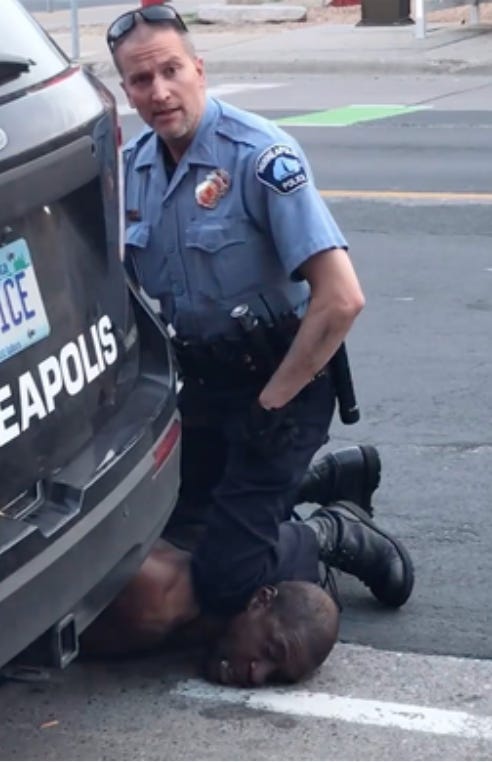
[image: George Floyd was suffocated to death on the street in 2020 by Derek Chauvin after the cop presumed he was out of control on drugs]
Alongside the mass-jailing of black people during the 1990s US crack epidemic, described by Michelle Alexander, as the “new Jim Crow”, the drug hammer was also being used to attack America’s white rural poor. Rising addiction to meth, then labelled ‘white man’s crack’, was used as an opportunity to sow panic and ramp-up policing in rural communities already on their knees, says Travis Linnemann, a criminologist at Kansas State University and author of the 2016 book Meth Wars. His book exposed the big gap between hype and reality, and how the authorities used the war against meth as an excuse to turn the police into something more akin to an army.
“[Meth] brought the drug war en masse to new territories. The rhetoric [around the meth epidemic] was used to justify increasing intrusion and police violence, a call for more cops, more funding for cops, that it’s fine for cops to have Kevlar helmets and assault rifles in a small town,” he told me when I interviewed him for VICE about his book. “We erect this kind of edifice, advance it and really what it does is accomplish other political goals underneath: it brings funding, political careers are made,” Linnemann said. “The authorities can [use drugs to] broaden the types of political power they have, expand the number of police, get them new equipment.”
His observations about meth have proved prescient. The conflation in the US of the war on drugs with the war on terrorism has been used as a lever to justify muscling-up the police, ICE and border security against enemies whose threat levels have been magnified. It is no surprise to Americans that heavily-armed ICE agents are treating anyone who gets in their way, including Renee Good, as domestic terrorists rather than local civil rights activists. Even the current fentanyl crisis, involving the deaths of hundreds of thousands of people, became an opportunity for the US government to peddle a false threat narrative: that police officers could be struck unconscious just by looking at the drug, and that the nation’s entire drug supply was being laced with fentanyl.
Alongside being an excuse to spread fear and ramp-up social control, drugs have also been used as a way to scapegoat the most vulnerable people, and as a convenient fig leaf for social problems. Why blame heroin addiction or child crack dealing on a lack of opportunity and equality, when you can simply blame it on people’s own weakness and greed, or more simply, on “drugs”?
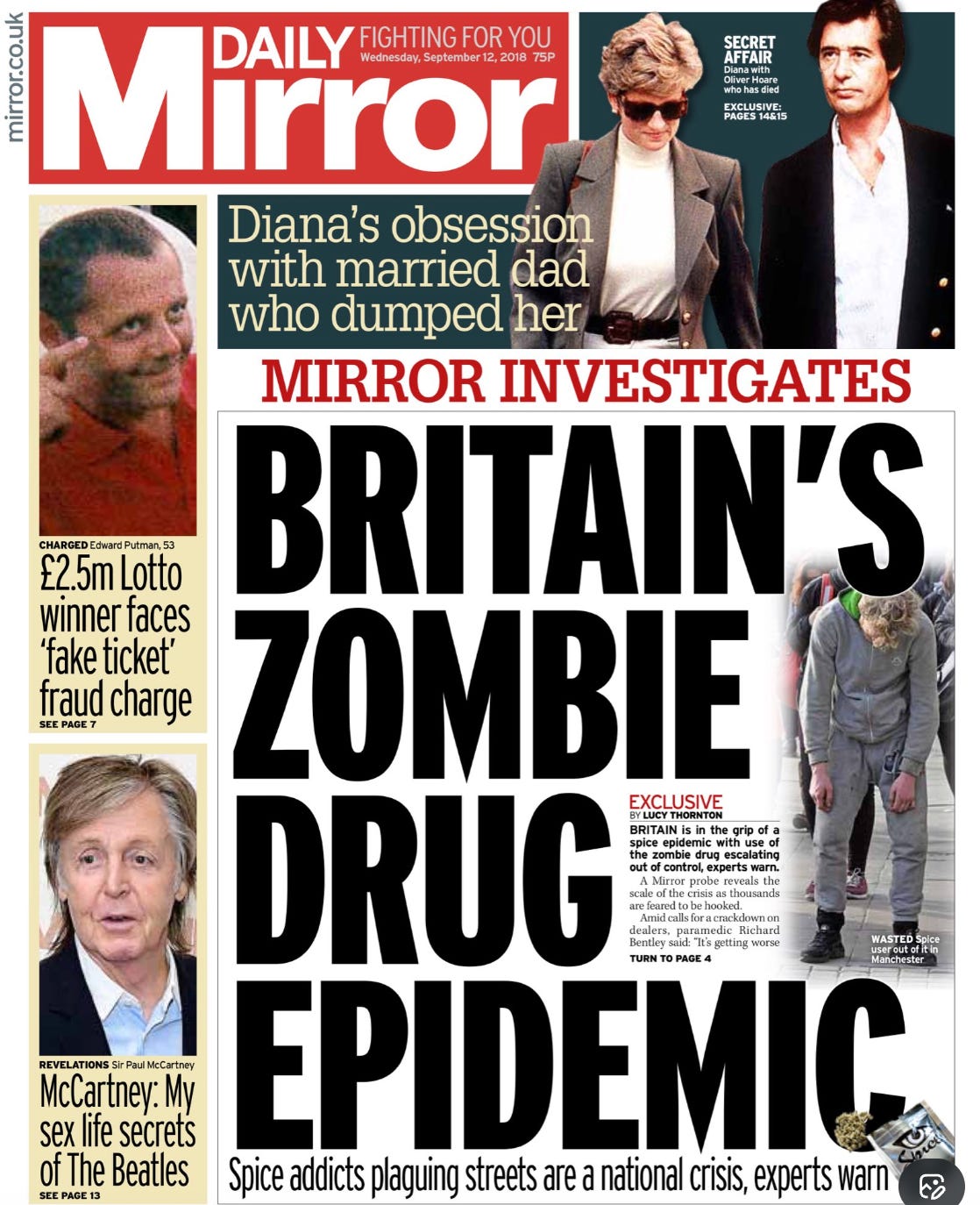
[image: Daily Mirror front page, 2018]
Ever since the ‘Faces of Meth’ pictures – before and after mugshots of the degraded meth addict – were drip-fed to the media by US police forces, junkie porn, whether it’s about Spice or Monkey Dust in the UK or synthetic opioids in the US, encourages people to diagnose others as monsters, rather than as casualties of a broken system.
“What these images do is hide longstanding social problems under the narrative of drugs,” Linnemann told me about meth in the US. “Jobs have gone because of corporate agriculture and the consolidation of family farms. But I think it’s easier to blame the local drug user.”
Drug users and dealers have been easy prey for regimes around the world seeking popularity in the name of an all out war against drugs. But in some countries, anti-drug policing has slipped into the mass slaughter of the poor.
In 2005 in Thailand, ruler Thaksin Shinawatra’s war on drugs resulted in the extra-judicial killing of thousands of people living in marginalised communities, after which an official investigation found more than half of those killed had no links to drugs.
When Philippines president Rodrigo Duterte oversaw the ‘meth war’ murder of an estimated 30,000 of his own citizens between 2016 and 2022, his public approval ratings rocketed. But investigations revealed that Duterte, himself addicted to drugs, and his death squads almost exclusively killed people living below the poverty line. “One of the main criticisms of Duterte’s drug war was that it was just targeted towards the poor,” says Natashya Gutierrez, a journalist who covered the story. “He has admitted to being addicted to fentanyl, so we can’t really say he is truly anti-drugs if that’s the case.”
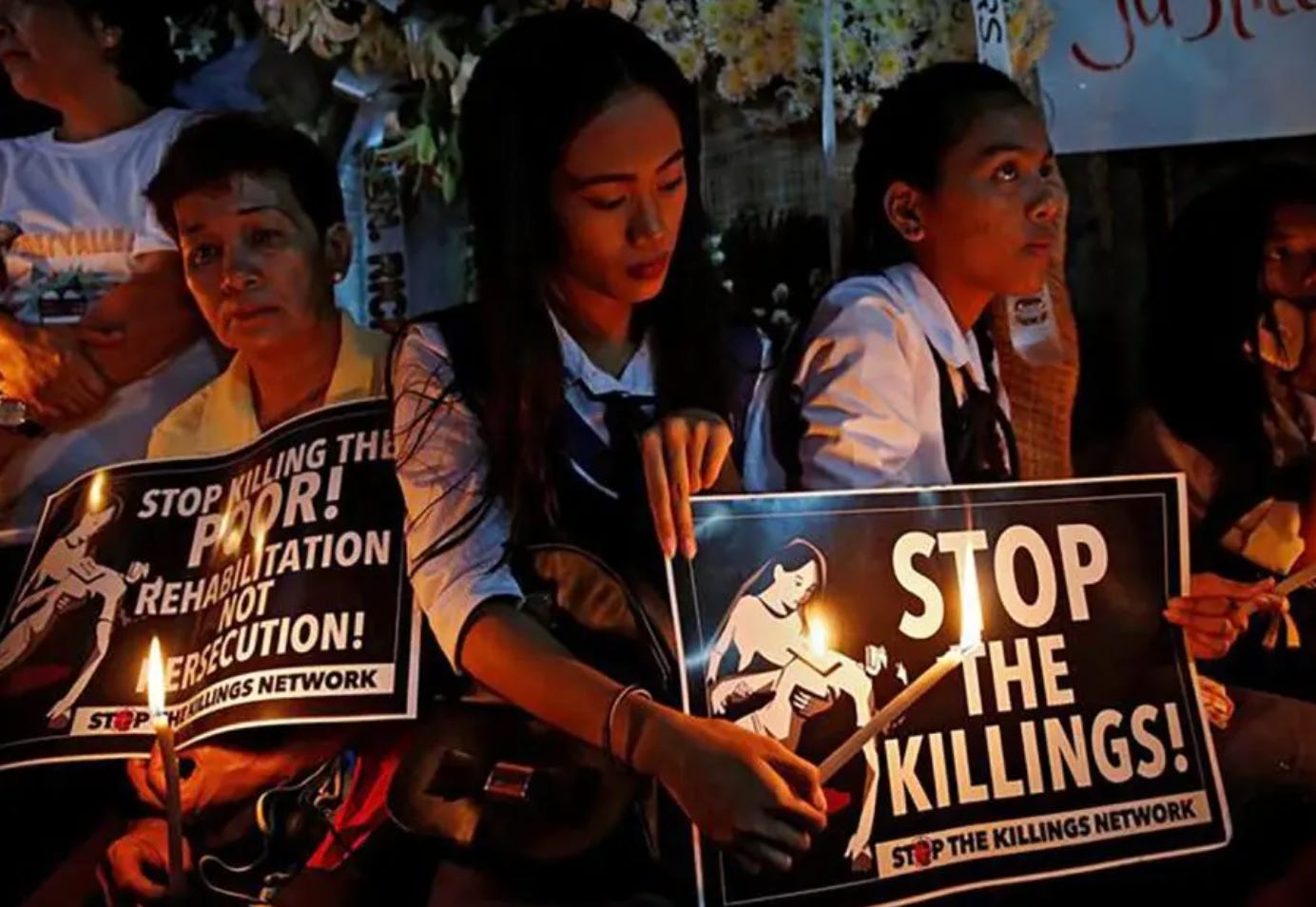
[image: Residents in Manila, Philippines at the wake in 2017 of a 17-year-old high school student, among those shot dead in President Rodrigo Duterte's ‘war on drugs’]
Drugs are not only the spark for horrors, they’re an ideal excuse for them too. During the heart-breaking rise in teenage street killings in London at the end of the 2010s, investigations found this extreme violence was most often being caused by petty or postcode-related beefs between kids growing up in a claustrophobic online world dominated by deep-seated inequality, austerity, failings in education and a lack of hope in the city’s poorest neighbourhoods. They were rarely linked to drugs. Nevertheless, the country’s most senior politicians and police chiefs span the bloodshed as everything to do with drug turf wars, while pointing the blame for these deaths at people who buy and sell drugs.
In fact, the UK government has been busy twisting its own homicide data to make drugs look culpable for as many murders as possible. The Home Office mantra is that “52% of homicides in England and Wales are drug-related” – a factoid cited in numerous government policy documents and repeated endlessly by politicians, police, academics and journalists.
But the statistic is made-up. These “drug related homicides” are not, as you would think, all about drug deals gone wrong, turf wars or drug debts. Instead, the Home Office’s definition of a drug-related homicide is so vague and catch-all that it can include any killing involving people who have ever used or sold drugs. So if someone was killed by a complete stranger, and either the victim or suspect happened to have been caught smoking cannabis 10 years beforehand, it could qualify for a “drug related homicide”. It’s a smoke and mirrors statistic designed to make the public look the other way and there’s a reason why it was created: because the government is desperate to prop up the fake narrative that drugs, and not the state of society, are to blame for people killing each other.
When politicians aren’t using drugs as an excuse for ignoring inequality, they’re using them to look tough on crime. They have done this by pushing a track record of half-baked, Daily Mail-friendly policies (targeting the non-existent school gate drug dealers, raiding middle class dinner parties, taking away cocaine users’ passports) onto the public. In some countries, drugs are just one way of targeting political opponents. In January, left wing Greek politician Yanis Varoufakis was arrested by police and accused of “aiding and abetting the narco-mafia” after he told a podcast he had taken ecstasy once, 36 years ago.
On the surface, those in power wholeheartedly disapprove of illegal drugs and punish people, especially if they are non-white or poor, accordingly. But as we can see, they also value drugs, because the immorality that surrounds these little plants growing in the soil or mounds of dust in a lab, can be milked for any number of underhand reasons. In the same way Christianity was used in the crusades, to those in power, drugs have become the perfect cover story to commit bad deeds and to persecute. Perhaps drug prohibition is less about moral authority than we think, because when they are legalised, drugs cannot be weaponised.
Really clear, interesting piece. I wondered about the motivation of some of the people involved in these discourses, at least in England/UK. It's not always conscious or with bad intent - which in some ways might make it more difficult to challenge and change. Advocates for substance use treatment have certainly used various 'drug-related' stats to justify maintaining or increasing investment in care and support for people experiencing harm related to substance use. And I think the UK politicians are less calculating than, say, the US in the Nixon era. Certainly at some points in their lives, most of them have espoused more liberal views on regulation, and it seems to be fear of media / public opinion that keeps them saying that drugs are bad and therefore must remain prohibited. Unfortunately, I don't know what that says about the priority they place on evidence or compassion, or how we should therefore campaign for better policy. Thanks again for writing.
The irony is that critics unthinkingly use Prohibitionist deceits eg the category error ‘illegal’ drugs and shoot us all in the foot